The book for your video

Vol. I
FIX THE HANDLE FIRST
Fresh grips, the right size and a lighter hold, before you buy another driver
$27

The book for the video you just watched:
For long-time golfers who've lost distance
The book for your video
Vol. I
Fresh grips, the right size and a lighter hold, before you buy another driver
$27
The book for your video

Vol. II
Tee height, shaft, ball and a full tank for the swing you have
$47
Best value
The book for your video

3 books for $97: $32.33 a book. 445 pages and 25 chapters in all.

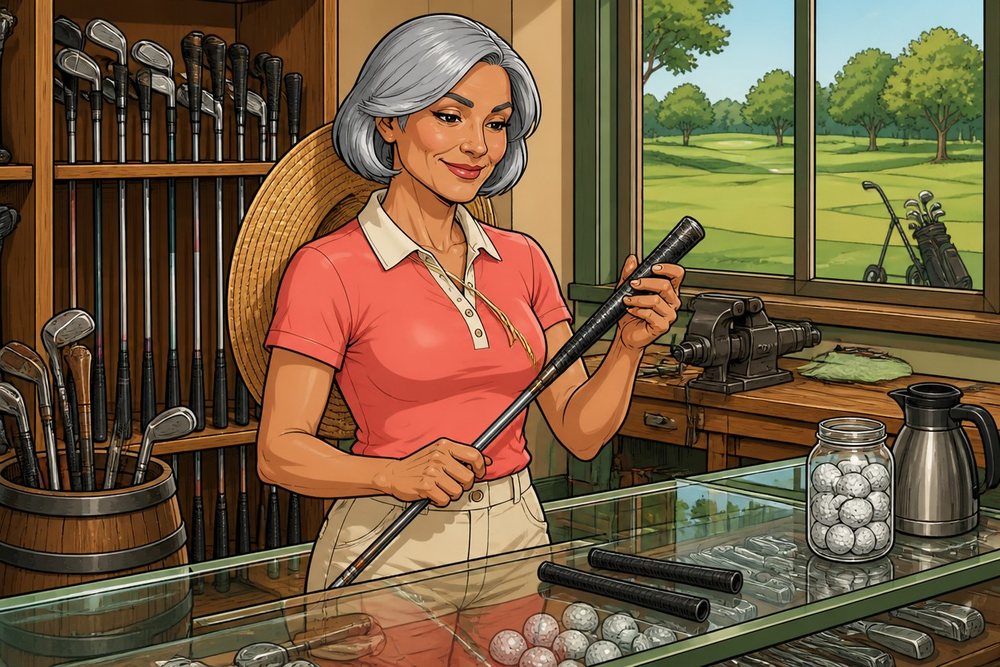
Cedar Fork, Ohio · runs the shop at the Muni · a drawn character, not a teaching pro
Check your grips, your tee and your bag before you touch your swing. I've spent twenty seasons at the counter and grip bench of our town course. My three books show you what to look at first.
I was born and raised in Cedar Fork, Ohio. I spent twenty years at the counter of Dunmore's Hardware, cutting keys and listening to men describe a problem badly. When Dunmore's closed, Vern hired me for the counter at Cedar Fork Municipal. We call it the Muni. I have run the shop since 2009.
Vern taught me to regrip that first winter. I slid my first grip on and was proud of myself. He set it in the vise and showed me the pattern sat a quarter turn off. Then he made me cut it off and do it again. Check it on the bench, not on the tee. Vern died in 2017. His vise is still bolted to the bench.
Most folks who come in wanting a new driver need new grips. Fix the cheap thing first.
I work in Industrial Maintenance. And after a long day of work and sneaking in a range session my hands were sore. I changed to these grips and after a bit of an adjustment period I love them. No pain after practicing or playing. …
— a viewer, under a video about playing with oversized grips · 403 likes
… The one thing I wasn't aware of was how heavy some the grips were. It changed my swing weight by a lot. And I played like that for several years. Last year I switched to the light version (which is same weight as standard grips) and it made a world of difference.
— a viewer, under a video about playing with oversized grips · 73 likes
I am 75 years old with a swing speed of mid 70's. After extensive testing the shaft that gives me the better distance and ball flight is stiff rated. The problem we all have is there is no standard measurement calibration between manufacturers. So a stiff shaft from one could be either Regular or Extra stiff from another make. Testing is the only way to find what is right for you.
— a viewer, under a video about choosing the right shaft flex · 56 likes
Age really takes its toll playing golf in regard to distance. I'm 73 now and hit my driver maybe 210-215 yds. When I was younger with older equipment I averaged around 270 yards. I used to hit my 8 iron and carry it 150 yds. Now it's 120 yds. …
— a viewer, under a video on the same problem · 19 likes
It's taken me a long time to realize that the key to lowering your scores is practicing your short game from 120 into the green.
— a viewer, under a video on the same problem · 22 likes
The problem with playing bogey golf to break 90 is that it doesnt get rid of blow up holes. It isnt that we couldnt break it if our mode shots per hole evened out. The problem comes with those 2-3 “outlier” holes we have per round where we shoot an 8 on a par 4.
— a viewer, under a video about breaking 90 without swing changes · 23 likes
These are public YouTube comments from people with the same problems, under other creators' videos. They are not reviews of these books.
Book I is the handle. Book II is the tee shot, the long clubs and the back nine. Book III is the whole round, and it only comes with the collection. You can buy Book I or Book II on its own.
The book for your video

Vol. I
Fresh grips, the right size and a lighter hold, before you buy another driver
For slick grips, sore hands that squeeze too hard, a slice that starts in your hold, and money spent on clubs that fixed nothing.


The book for your video

Vol. II
Tee height, shaft, ball and a full tank for the swing you have
For the drive that gets shorter every year, long irons that all land in the same place, and an empty tank on the back nine.



The book for your video

Vol. III
The whole round on the bench: rolling chips, close first putts, clubs you trust
For the three-putts and the two or three blow-up holes that keep you from breaking 90, and for never knowing which shot will show up.



| Book | Pages | Chapters | Jobs | Price |
|---|---|---|---|---|
| Vol. I · FIX THE HANDLE FIRST | 137 | 8 | 17 | $27 |
| Vol. II · DISTANCE WITHOUT STRAIN | 137 | 8 | 15 | $47 |
| Vol. III · THE BENCH METHOD | 171 | 9 | 20 | In the set |


June 1999. My brother Cliff's Thursday night league was one player short, so I borrowed a set and went. I held that club the way I held a claw hammer at the hardware store. White knuckles, forearms like rope, every ball going right. I shot 68 for nine holes. I was hooked by the fourth.
I swung hard and it went nowhere, and I blamed my swing for years. It was my hands. They are the only part of you touching the club. I was holding it like it owed me money, when I should have held it like a full coffee cup I didn't want to spill.
Since then I've stood at the counter and the grip bench of our town course for twenty seasons. The same thing walks in every week. A good player who has lost distance and wants a new driver. I pick up his 7-iron and the grip is shiny as a bowling ball.
So I wrote down what I look at, in the order I look at it. The handle first. Then the tee, the shaft, the ball and the long clubs. Then the card, the chips and the first putt. One job a week, with the clubs you already own.
I am not a teaching pro and I won't touch your swing. I can't promise you a number. I can show you where to look before you spend another dollar on a club head.
That's the bench for today. Come by the shop.Bonnie
Choose the set or one book and pay on Payhip's secure page.
Your books are ready on the very next page, and a link to them also arrives in your inbox.
Open them on your phone, tablet or computer, or print them at home. The type is large.
Read my books for 7 days. If they are not for you, ask for your money back and you will get all of it. I may ask what didn't work, because I'd like to know. You get your refund whatever you answer, and also if you don't answer at all.
Get the complete set7-day money-back guarantee · one-time payment

The first chapter of FIX THE HANDLE FIRST, "Read the Rubber". The real chapter, large print, right here on this page.

Type your email and Chapter 1 of FIX THE HANDLE FIRST opens right here. I'll also email you the PDF to keep.
Tell me what held you back and I'll email you a one-time link back to $97.
BonnieFIX THE HANDLE FIRST · Chapter 1That's Chapter 1. The whole plan, in order, is in the three books.
Get all 3 booksMarv is one of my Tuesday bunch. He came in this spring for a new driver, his third in four years, and he had the money out before he had his cap off.
I asked to see his 7-iron first. I always do. The grip was as shiny as a bowling ball. I turned his glove over and the heel was worn clean through.
“How long have these been on?” I asked. Marv looked at the ceiling and counted presidents.
He was about to pay for distance at the head of the club while the handle slid around in his hand. I’ve sold that mistake. Plenty of times, in my first years, because a driver is a nice sale and I didn’t know to look.
That day I sold him grips. He grumbled the whole time I rang it up.
Your hands are the only part of you touching the club. When the rubber goes hard and smooth, the club wants to turn in your fingers, and you stop it the only way you can. You squeeze.
Squeezing is work. It tightens your wrists and forearms, and a tight arm swings slow. A worn grip costs you twice: the face can twist when you hit the ball, and you are tired from hanging on.
Rubber does not fail all at once. You adjust without noticing, one small squeeze at a time.
Take one club to the window. You are looking for four things.
Where: the kitchen table or the garage floor. You need: every club in the bag, good light, a pencil.
Now look at which clubs landed where. It is almost never even.
The clubs you love wear out first: the driver, the 7-iron, the wedge you chip with. The 4-iron you gave up on will look brand new. Your favorite clubs need help soonest, and some of the others are just along for the ride. We get to those in Chapter 8.
Leave the putter out of the piles for now. A putter gets a soft hold and its grip lasts a long time. Check it the same way, and do not be surprised if it passes.
Next: the Wash pile, and a bucket.
Arrives instantly. As soon as you pay, the books are yours to open on your phone, your tablet or your computer. Nothing is shipped and nothing comes to your mailbox. You can print any page at home, and the bench cards are worth printing. If you wanted paper books in a box, ask for a refund and you'll get it.
You pay with card or PayPal, the same way you would anywhere else. The price is on this page. You pay once.
You have 7 days. Ask for your money back and you get it. I may ask what didn't work, but the refund doesn't depend on your answer.
Book I and Book II are each sold on their own. Book III, THE BENCH METHOD, only comes in the collection of 3 books.
Folks who have played for years and shoot in the 90s or the low 100s. I don't explain the game. I start with the clubs in your bag and what has changed in how they work for you.
Most Jobs use the clubs you already own, a marker and a towel. If you regrip at home you'll need new grips, tape, solvent, a hook blade and a vise with rubber jaws. If you'd rather not, the book still tells you which clubs earn new grips, and a shop can put them on.
No. I'm a drawn character, and the books are written in my voice. Cliff, Vern and the Muni are part of my story. They are not customer reviews. The Jobs, the checks and the safety rules in the books are real, and you can try every one of them yourself.
I can't promise you a yardage or a score, and I wouldn't trust anyone who did. Breaking 90 is the goal of Book III, and it took me until I was 44. What I can do is show you what to check, in order, starting with the cheapest thing.
Yes. Every chapter has a “Left-handed?” box, and each book has a section called “For Left-Handed Golfers”.
I fix grips, not hands. A thicker or softer grip is about comfort and holding on with less squeeze. It is not a treatment for anything. Book I has a chapter called “The Size That Fits”, and I tell you to try one club before you pay for a whole set. If you feel pain or numbness, stop and ask your doctor.
Yes, if you go slow and set the bench up safe. The chapter is “New Grips at Home” in Book I. Work somewhere ventilated. Keep the solvent away from flames and sparks. Cut away from your body. Hold the club in a vise with rubber jaws, and follow the label on your solvent and tape. My first grip went on crooked, so you're in good company.
By feel and by how the ball flies, not by a number on a screen. That is the chapter “The Shaft for the Swing You Bring” in Book II. A softer shaft is not a surrender. It is the right tool. The book helps you decide. The shaft change itself is a job for a shop.
You're not alone at my counter. Book II has a chapter called “Long Irons That Land Together” and a Job called “Lofts in a Row”. You see where they land at the range, then cover the gap with a hybrid or a wood with more loft. I carry twelve clubs myself. No 3-iron, no 4-iron.
It is, and I've been there. I once shot 42 on the front and 50 on the back, three rounds in a row, on coffee and no lunch. The chapter is “A Full Tank at the Turn” in Book II. It is water, half a sandwich, shade and sitting down while the others hit. No exercises and no diet. If you feel dizzy or unwell, stop and ask your doctor.
That is most of Book III. In “Read the card” you find where the shots go. In “The safe way out” you learn to lay up without shame. I broke 90 with two lay-ups on the last hole, after years of going for it and making eight.
With the first putt, not the short one. I circled my three-putts for a month and found nine a round. I had been practicing four-footers. The chapter is “Long putts to a towel” in Book III, and there is a Job called “The Towel Ladder”. The putting green is the cheapest lesson at any course, and it's empty.
No. You pay once and the books are yours to keep. Nothing renews and nothing else is charged. The only monthly thing on this page is the club, and only if you choose to join it.

Start with the handle. Then the tee, the shaft and the long clubs. Then the card and the first putt. One job a week, with the clubs you already own. You have 7 days to read my 3 books and decide if they belong in your bag.
3 books for $97: $32.33 a book. 445 pages and 25 chapters in all.
P.S. All three books together are $97, paid once, not a subscription. If they don't help you, write to me within 7 days and you get your money back.— Bonnie
★ Members only · Bonnie's Bench Letter
Every Saturday, a letter from Bonnie.
$9.99 / month
Join the club →$9.99 a month. Cancel any time with one click, at the bottom of every letter.
A short email each Saturday: the one thing of the week. No card. The full letter and the archive are for members.
Free. One click to stop. Your address is used for this and nothing else. · Or see the club ↑


